

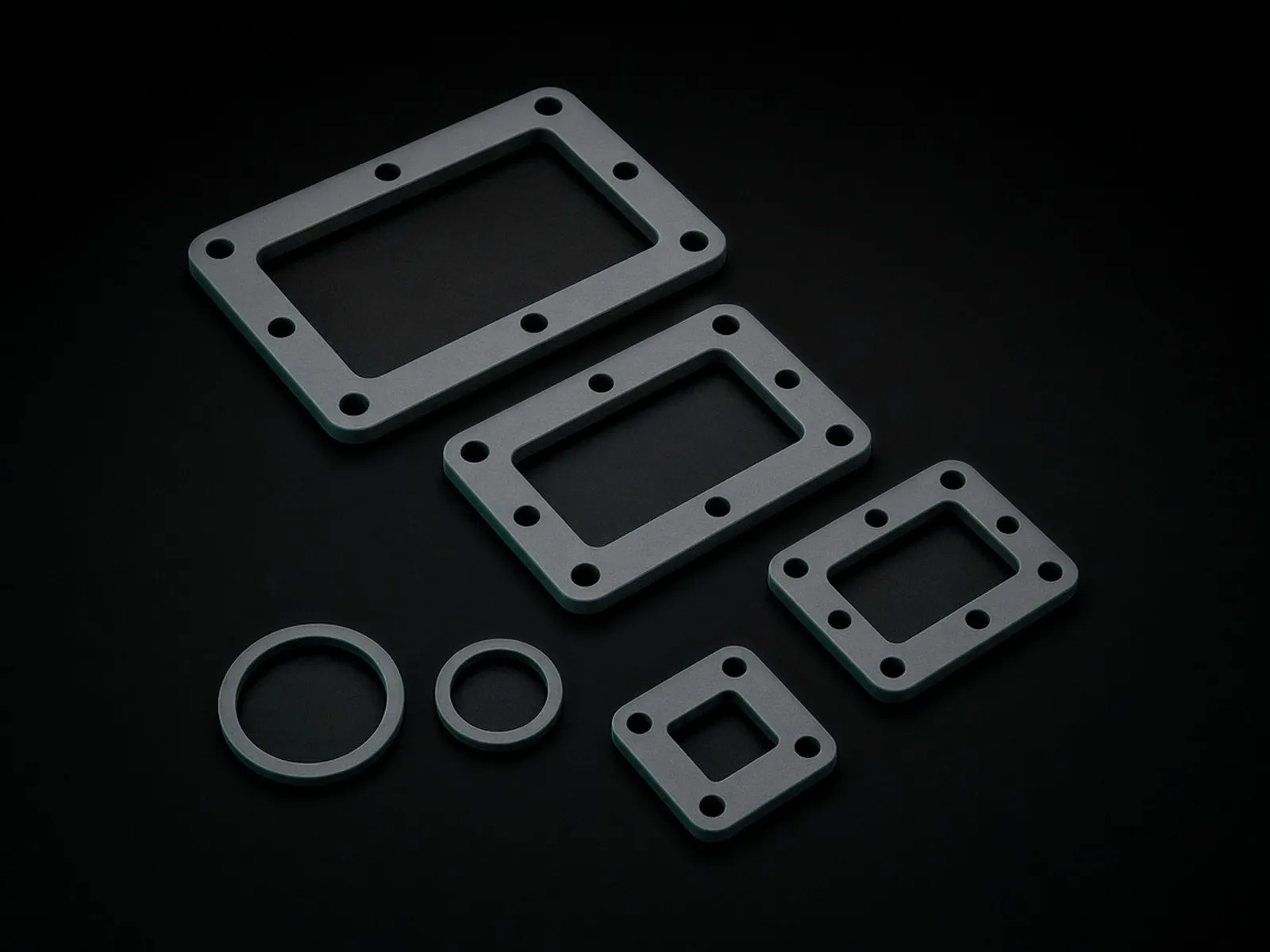
Conductive silicone does two jobs at once: it grounds the joint and shields against EMI, and it seals the joint against the environment. The question is usually not whether to use it, but in which form: a separate gasket, or a bead dispensed straight onto the enclosure.
Separate gaskets: die-cut, extruded and molded
Conductive silicone can be die-cut from sheet, extruded into strips and profiles, molded into seals, co-extruded with non-conductive rubber, or surface-coated. Separate gaskets suit:
- wider flanges and simple outlines, such as covers and panels;
- doors and lids that open, where an extruded strip runs along the edge;
- lower volumes, or lines without dispensing equipment;
- designs where the gasket must be replaceable in service.
Form-in-place (FIP)
With FIP, conductive paste is dispensed onto the enclosure by a programmed machine and cured into an elastic gasket. It suits:
- narrow flanges and thin walls where a cut gasket is hard to place;
- complex paths, including multi-cavity enclosures;
- higher volumes on an automated line, with no gasket inventory per shape.
FIP is widely used in telecom equipment, consumer electronics, automotive electronics and medical electronics.
Choosing the filler
Both forms are filled with conductive particles. For FIP pastes, fillers include silver/nickel, silver/aluminum, silver/copper and nickel/graphite. The choice depends on the shielding the design needs, the metal of the mating surfaces, the environment and cost. As a general rule, pick a filler that is compatible with the enclosure metal to limit galvanic corrosion at the joint.
Summary
| Design | Usually a good fit |
|---|---|
| Wide flange, simple outline, low volume | Die-cut or molded gasket |
| Opening door or lid | Extruded conductive strip |
| Narrow flange, complex path, high volume | FIP conductive paste |
If you are not sure, send the enclosure drawing and we can suggest a form. See also form-in-place conductive paste and conductive rubber.