

Electromagnetic absorber materials take in incident electromagnetic waves and turn that energy into heat. This is different from a conductive shield, which reflects electromagnetic waves. Reflection keeps energy out, but inside a closed device enclosure the reflected energy can bounce around, cause secondary radiation and interfere with the circuit. Microwave absorbers are used to deal with that energy instead of reflecting it.
Thin silicone EMI absorber sheets
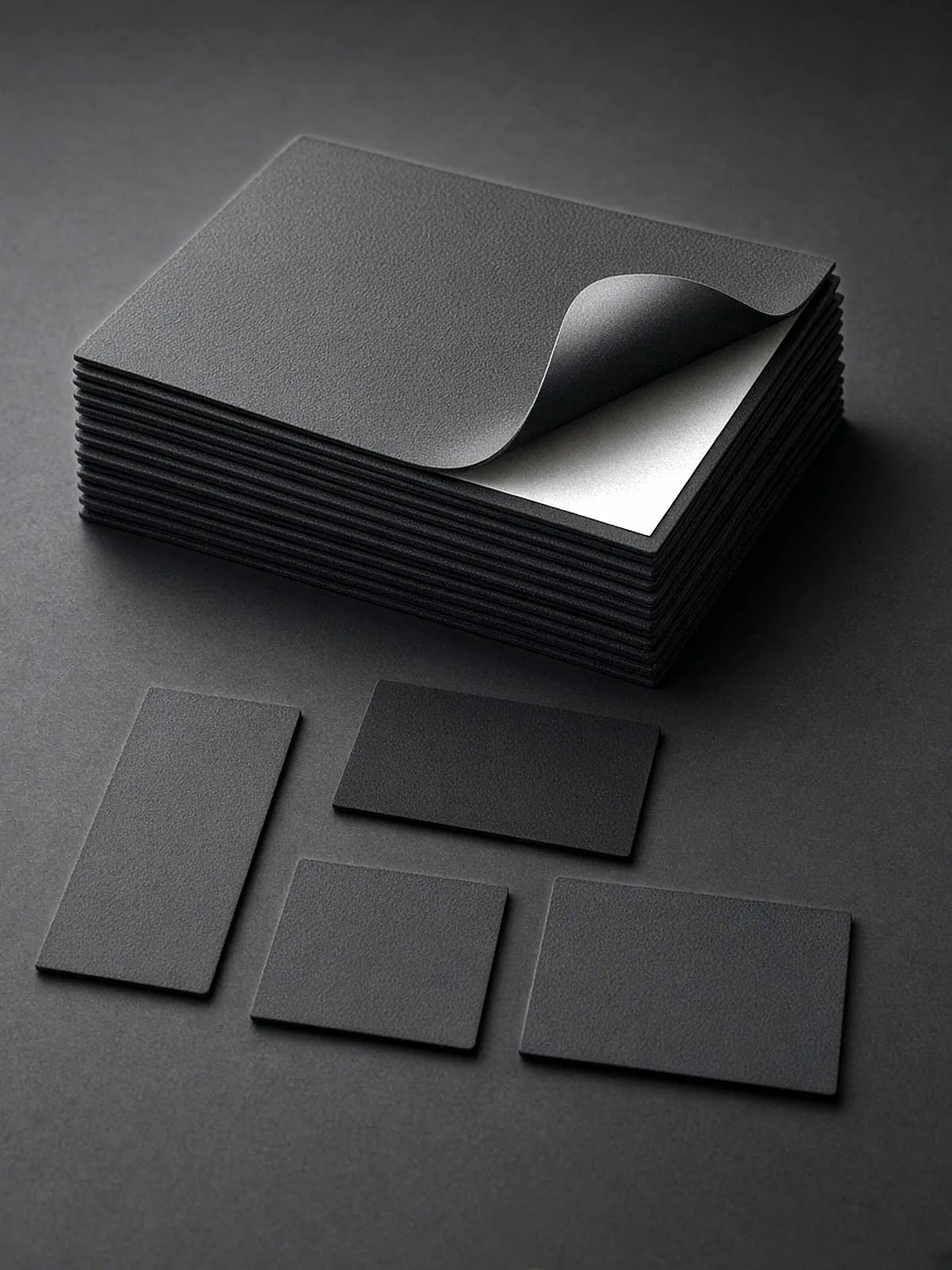
Silicone EMI absorber sheets are made of silicone rubber filled with magnetic powder. They are thin, electrically insulating, and are bonded or pressed onto a metal base plate. They can be supplied with adhesive backing and die-cut to shape.
Typical use: lining the inside of sealed cavities and shielded enclosures to suppress electromagnetic noise, reduce standing waves from microwave resonance in the enclosure and lower the Q of the cavity.
Choose sheets when space is tight and the microwave absorber has to sit on a metal surface, such as a lid or a shield can.
Microwave absorber foam
Microwave absorber foam uses a polyurethane foam base. It is much thicker than a sheet and is used to:
- fill the space around antennas to improve isolation and reduce sidelobes;
- be die-cut into parts that sit inside microwave cavities to reduce interference;
- serve as linings inside radomes and shielded test boxes.
With weather treatment, it can be used outdoors. Choose microwave absorber foam when there is room for a thicker part and the goal is to fill a volume rather than line a surface.
Two related options
- Thermally conductive absorber pads absorb electromagnetic energy and conduct heat at the same time. They are used in optical communication modules, where one part must do both jobs.
- Soft magnetic sheets have high permeability and work at lower frequencies. They are placed directly on the interference source, in products such as phones, computers, digital cameras, TVs, set-top boxes and GPS units.
Frequency comes first
Every microwave absorber works best over a certain frequency range, and thickness is tuned to it. Start from the frequency band of the problem, for example the L, S, C, X, Ku, K or Ka band, then choose the type and thickness that targets it. Testing in the real device enclosure is the most reliable check.
| Situation | Usually a good fit |
|---|---|
| Thin layer on a lid, shield can or cavity wall | Silicone EMI absorber sheet |
| Filling a volume, around antennas or in test boxes | Microwave absorber foam |
| Part must also move heat | Thermally conductive absorber pad |
| Lower-frequency noise at the source | Soft magnetic sheet |