

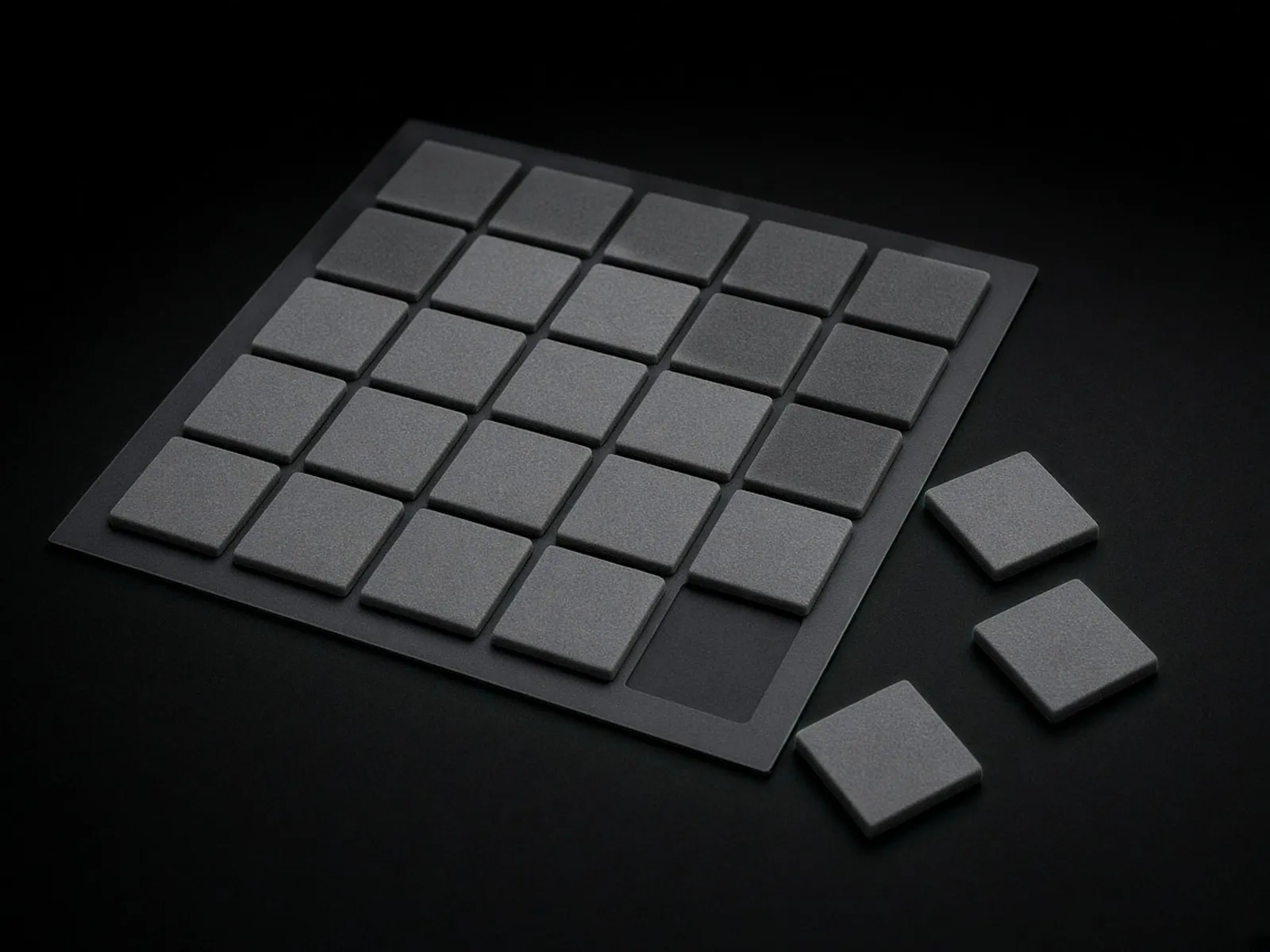
A thermal pad sits between a component and a heatsink or enclosure. Its job is to fill that gap and push the air out of the interface, because trapped air conducts heat poorly. Thickness and hardness decide whether it can do that job without causing new problems.
Start from the real gap
Measure or calculate the gap between the top of the component and the cooling surface in the assembled product, not on a single nominal drawing. Add up the tolerances: component height, solder joint, board flatness, standoff height and enclosure flatness. On a board with several components under one heatsink, each component usually has its own gap.
A pad is normally chosen slightly thicker than the largest expected gap, so that it is always under some compression. A pad that only just touches the surfaces can leave air pockets where tolerances work against you.
How much compression
Compression is what makes the pad conform to the surfaces. Too little and contact is poor; too much and the pad pushes hard on the component and the board. The right amount depends on the pad’s softness and on how much force the assembly can take. Ask for the compression–force behaviour of the grade you are considering rather than assuming one figure fits all.
Thinner bond lines conduct heat better, so there is no benefit in choosing a much thicker pad than the gap requires.
Hardness: soft enough to conform, firm enough to handle
Thermal pad hardness is usually given on the Shore OO scale. Softer pads:
- conform to uneven surfaces and components of different heights;
- put less force on solder joints, chips and thin boards;
- are more delicate to handle and place.
Firmer pads are easier to handle and die-cut cleanly, but need more force to compress. Soft, resilient pads also help lower structural stress and protect the chip, which matters on large packages and thin boards.
Other points to check
- Silicone sensitivity. If the product is sensitive to silicone, for example optics, consider silicone-free pads.
- Electrical insulation. If the pad bridges a live part and a metal enclosure, check the insulation requirement.
- Assembly. Die-cut pads on a liner speed up placement on the line.
If the gap varies a lot across the board, a dispensable thermal gel may be a better fit than a stack of different pad thicknesses. See thermal pad, gel or grease.