

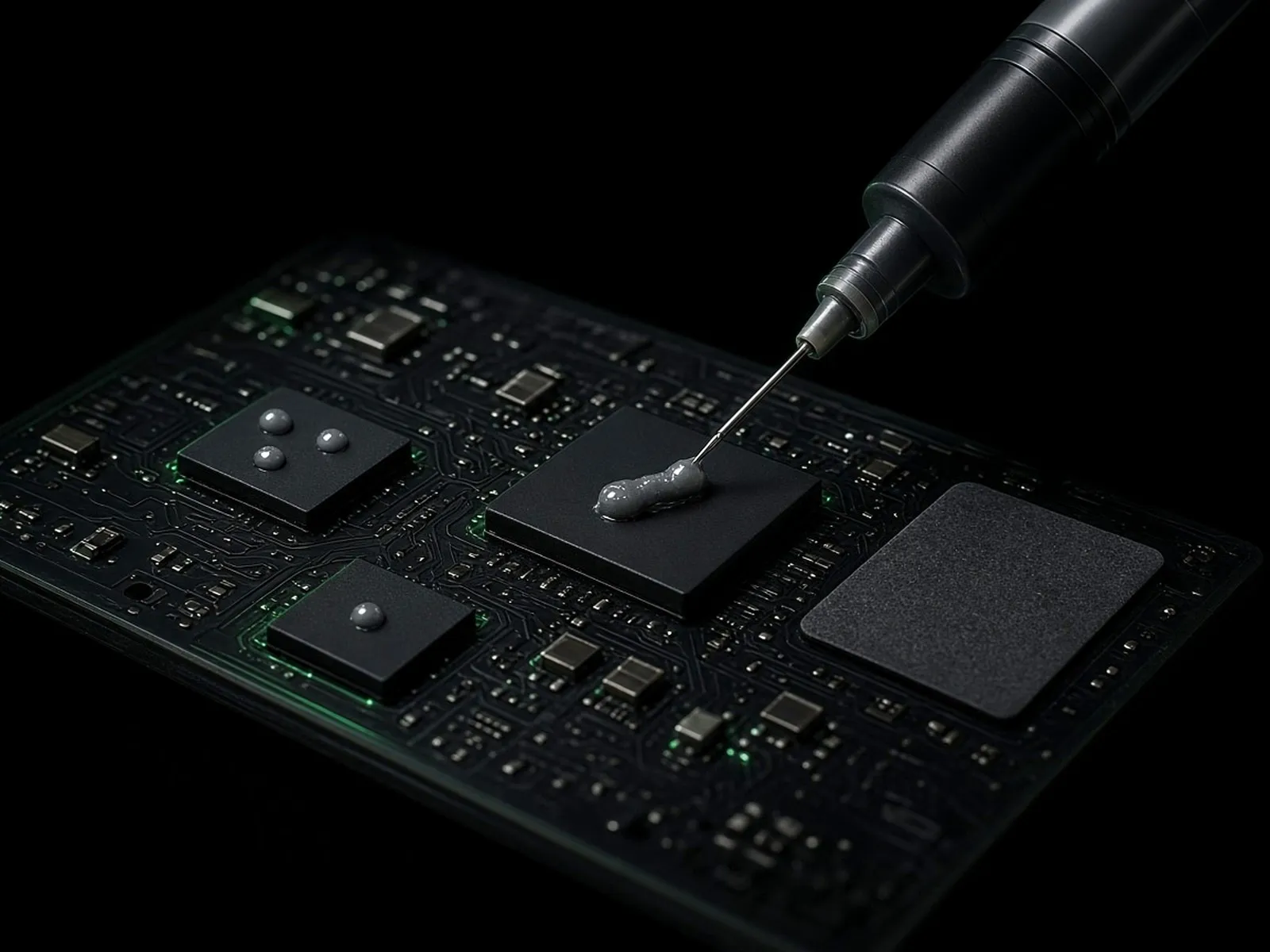
Thermal pads, thermal gels, thermal grease and phase change materials all do the same basic job: fill the interface between a heat source and a cooling part so heat can flow across it. They differ in form, and that changes how they fit the design and the production line.
Thermal pads
Pads are solid, pre-formed sheets, die-cut to shape. They are a good fit when:
- the gap is known and fairly consistent;
- parts are assembled by hand or in low volume;
- you want a clean part that can be inspected and replaced.
Their limits: each gap needs a suitable thickness, and a pad that is too thick for the gap puts load on the component.
Thermal gels
Gels are dispensed as a paste and take the shape of the gap. One-part, two-part and curable gels are available. Gels suit:
- gaps that vary between components or between units;
- automated dispensing on the line;
- fragile components, because a gel needs little force to spread.
Curable and two-part gels set after dispensing, which helps keep the material in place.
Thermal grease
Grease spreads into a very thin layer. It suits flat, closely matched surfaces where the bond line can be kept very thin, such as a processor and a heatsink clamped together. It is not meant to fill large gaps.
Phase change materials
Phase change sheets are handled like a thin pad, then change phase at operating temperature and wet the surfaces like thermal grease. They combine the clean handling of a sheet with a thin bond line.
A quick way to decide
| Situation | Usually a good fit |
|---|---|
| Known, consistent gap; manual assembly | Thermal pad |
| Uneven or varying gaps; automated line | Thermal gel |
| Flat surfaces clamped together; thin bond line | Thermal grease or phase change |
When the choice is close, make samples of two options and compare them in the real assembly. For pad sizing, see how to choose thermal pad thickness and hardness.