

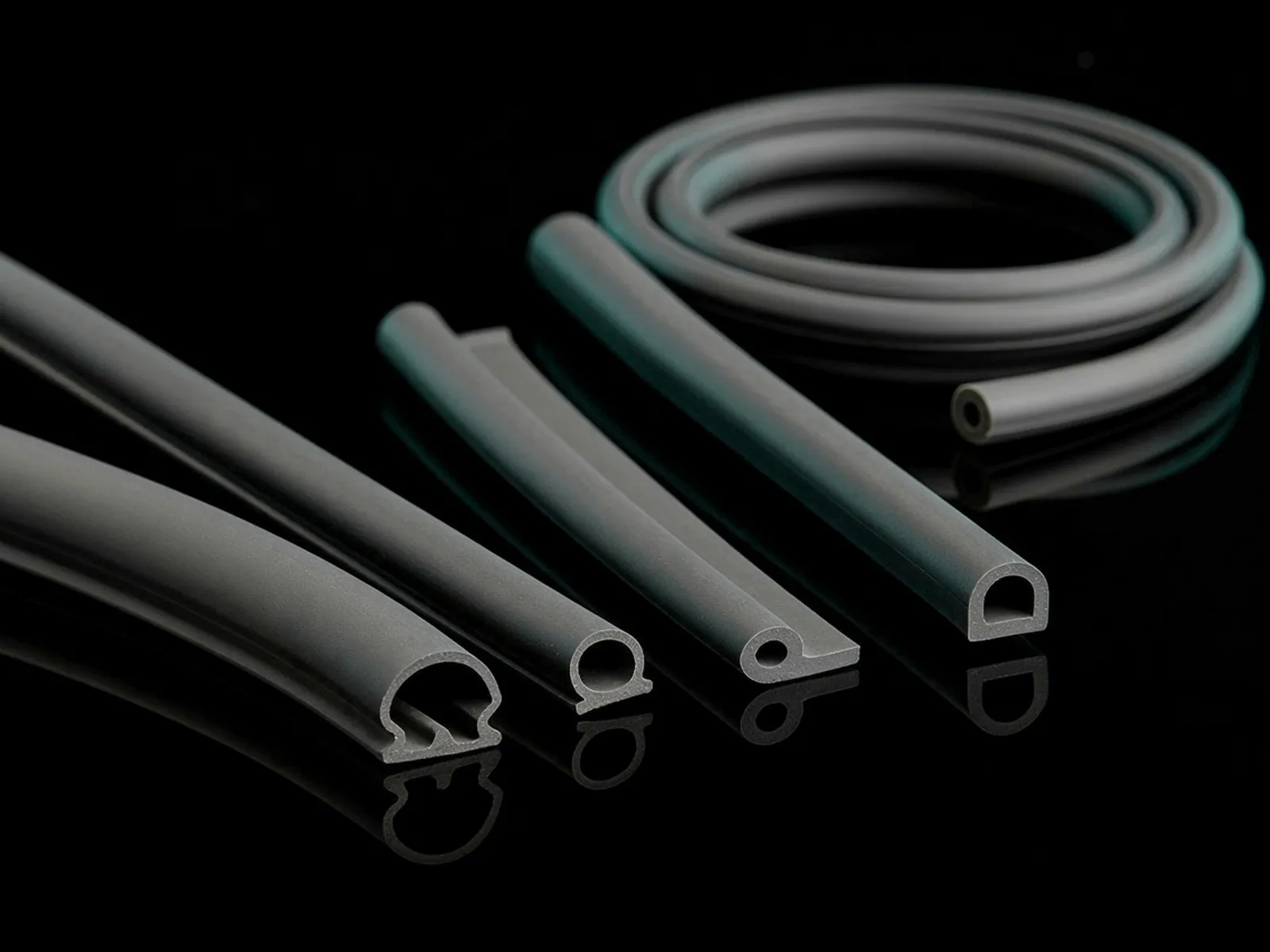
A conductive silicone gasket on a telecom cabinet door, an outdoor base station housing or a power controller enclosure has two jobs: carry current across the joint so the enclosure shields, and keep water and dust out. The silicone does the sealing. The filler particles do the conducting, and the filler has to be chosen before the part can be quoted and made.
Two common choices are pure silver (Ag) and silver-plated aluminum (Ag/Al). Below are typical values from the material datasheets of two of our grades, one of each.
The numbers side by side
| Typical value | Ag filled | Ag/Al filled |
|---|---|---|
| Volume resistivity | 0.002 Ω·cm | 0.008 Ω·cm |
| Shielding effectiveness at 500 MHz | 115 dB | 110 dB |
| Shielding effectiveness at 2 GHz | 120 dB | 105 dB |
| Shielding effectiveness at 10 GHz | 120 dB | 100 dB |
| Density | 4.3 g/cm³ | 2.2 g/cm³ |
| Hardness | 70 Shore A | 65 Shore A |
| Tensile strength | ≥ 150 psi | 180 psi |
| Elongation | ≥ 100 % | 150 % |
| Operating temperature | −55 to +170 °C | −55 to +170 °C |
Typical values, not a specification. Grades and properties can be adjusted to your requirements.
Two things stand out. The gap in shielding grows with frequency: 5 dB apart at 500 MHz, 20 dB apart at 10 GHz. And the silver-filled material is roughly twice as heavy for the same volume.
When pure silver earns its cost
Silver is the expensive part of either material, and a fully silver-filled compound carries far more of it. It is worth paying for when:
- the design needs the most shielding margin at higher frequencies, where the Ag/Al grade drops off;
- the joint is also a grounding path and the lowest contact resistance matters;
- the gasket is small, such as connector seals and small die-cut frames, so the extra weight and material cost per part stay modest.
When silver-aluminum is the better fit
Ag/Al tends to suit large and long parts:
- Weight. At 4.3 versus 2.2 g/cm³, every 100 cm³ of gasket weighs about 430 g in the silver grade and about 220 g in the Ag/Al grade. On a long door strip or a large cabinet gasket, that difference is real, especially on pole-mounted or portable equipment.
- Aluminum enclosures. The particle core is aluminum, so the filler is closer to an aluminum flange than pure silver is. As a general rule, pick a filler compatible with the mating metal and its finish to limit galvanic corrosion at the joint; we covered this briefly in conductive gasket or FIP.
- Softer and more elastic. 65 Shore A and higher elongation make it a little more forgiving on long strips and on covers with fewer fasteners.
If 100 to 110 dB across the band covers your requirement with margin, Ag/Al usually does the job at lower weight and cost.
The material number is not the joint number
Datasheet shielding values are measured on the material in a test setup. The shielding of the finished enclosure also depends on flange flatness, fastener spacing, the gasket cross-section and how far it is compressed. A better filler will not make up for a gasket that is under-compressed between two widely spaced screws. Settle the cross-section and the compression range first, then choose the filler that gives enough margin for the frequencies you care about.
Same shapes either way
Both materials can be supplied as sheets, die-cut gaskets, molded seals and extruded strips or profiles, so the filler choice does not limit the part geometry. See conductive rubber for strips and molded seals, and conductive sheets and die-cut parts for flat gaskets.
If a project needs measured shielding or resistance data on finished parts, samples are sent to a third-party lab for testing at the customer’s request.
Not sure which filler fits? Send the enclosure drawing, the flange material and finish, and the frequency range you need to shield, and we will suggest a grade and a cross-section.